Chimneys in Bridgeport draw wildlife because an uncapped clay flue reads to an animal as a hollow, sheltered tree. Chimney swifts (a federally protected migratory bird), starlings, and squirrels nest inside the smoke…
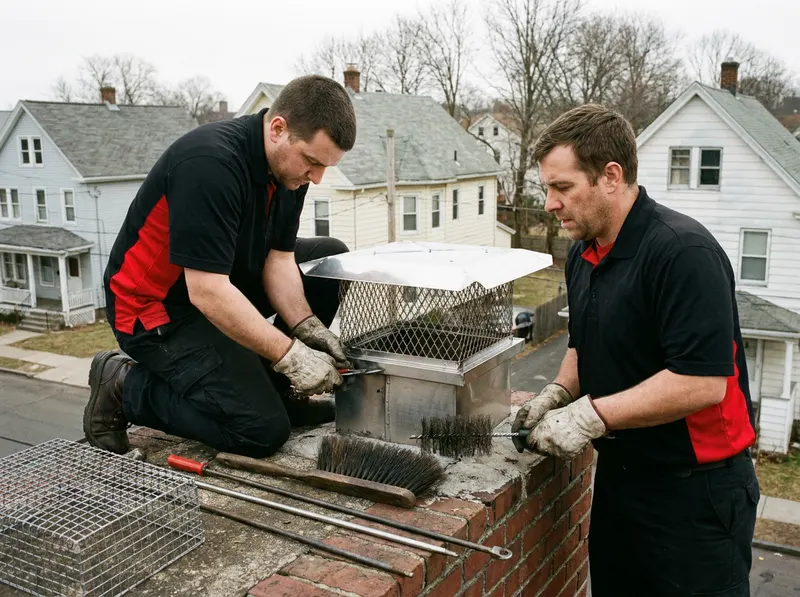
Chimneys in Bridgeport draw wildlife because an uncapped clay flue reads to an animal as a hollow, sheltered tree. Chimney swifts (a federally protected migratory bird), starlings, and squirrels nest inside the smoke chamber; raccoons wedge into an open flue tile to den and raise kits in spring. A nest of twigs sitting on a smoke shelf is both a flow blockage and a fire load, the Chimney Safety Institute of America (CSIA) treats combustible debris in a flue as a condition that must be cleared before the appliance is used. Removal starts with a top-down camera pass to see what is inside and where it sits, then extraction from the roof or firebox, then a cleanout of the loose material left behind.
Which fix fits depends on what is inside. If a single bird is fluttering in the smoke chamber and can be reached from the firebox, the visit is short and inexpensive. If a raccoon has denned with kits, the animal is removed humanely first and the flue is cleaned afterward, separating the removal from the cleaning is normal, not an upcharge trick. If there is a bulky twig nest packed onto the smoke shelf, expect a full clean out of the chimney rather than a quick pull, because compacted nesting material coats the flue in the same way creosote does. Chimney swift nests are the exception: the birds are protected under the Migratory Bird Treaty Act, so an active swift nest cannot be removed until the young have fledged and left on their own.
The permanent fix is a cap with mesh. A custom chimney animal guard, ideally 316 stainless mesh, which resists coastal salt corrosion far better than galvanized or 304 steel near Seaside Park, Black Rock Harbor, and the South End waterfront, screens the flue opening against birds, raccoons, and squirrels while still passing exhaust. 316 stainless holds up in the salt-laden air off Long Island Sound where thinner caps rust through in a few seasons. Standard-size caps fit most single flues; multi-flue chimneys on older Brooklawn and North End homes, or oversized masonry tops in Mill Hill and the Hollow, take a custom-fabricated cap sized to the crown. A spark arrestor also does its named job, it holds embers inside the flue rather than letting them land on a wood-shingle or torch-down roof, which matters on the tightly spaced houses of the East Side and Success Village.
After any removal, a Level 2 inspection with a camera documents the interior of the flue, per NFPA 211, which sets the standard for chimney and vent inspection and describes Level 1 and Level 2 scopes. Photos of the cleared flue are provided so the condition is verifiable rather than described. A free on-site estimate is available before any work begins; homeowners comparing options can get some quotes and see the cap material and dimensions in writing first.
Every job gets a firm, written price after a free on-site visit.
Tell us about your animal removal & spark arrestor job in Bridgeport and we'll send a clear, written quote, usually the same day.
 Sweepmaster Chimney Sweep